Germinal centers or germinal centres (GCs) are sites within secondary lymphoid organs – lymph nodes and the spleen[1] – where mature B cells proliferate, differentiate, and mutate their antibody genes (through somatic hypermutation aimed at achieving higher affinity) during a normal immune response to an infection. These develop dynamically after the activation of follicular B cells by T-dependent antigen.
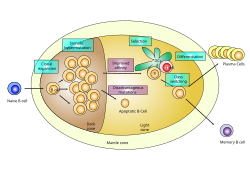
As they undergo rapid and mutative cellular division, B cells of the germinal center are known as centroblasts. Once these B cells have stopped proliferating, they are known as centrocytes, and are subjected to selection by follicular helper T (TFH) cells in the presence of follicular dendritic cells (FDCs). Germinal centers are an important part of the B cell humoral immune response, acting as central factories for the generation of affinity matured B cells specialized in producing improved antibodies that effectively recognize infectious agents, and for the production of durable memory B cells.
Process
Morphology at different stages
The morphology of GCs is very specific and shows properties which are characteristic for different stages of the reaction.
- In an early state of the reaction a network of FDCs is fully filled with proliferating B cells.
- Later at day 4 of the reaction, GCs show a separation of two zones, the dark and the light zone.[3] The former still contains dominantly proliferating and mutating B cells while the latter one is the area of B cell selection.
- These zones dissolve after 10 days of GC development which ends after about 3 weeks.
Medical relevance
As germinal centers are important structures of the adaptive immune system, their deregulation is implied in many immune diseases, for example rheumatoid arthritis, immunodeficiency and many lymphomas like DLBCL and Burkitt's lymphoma.
| This article uses material from the Wikipedia article Metasyntactic variable, which is released under the Creative Commons Attribution-ShareAlike 3.0 Unported License. |